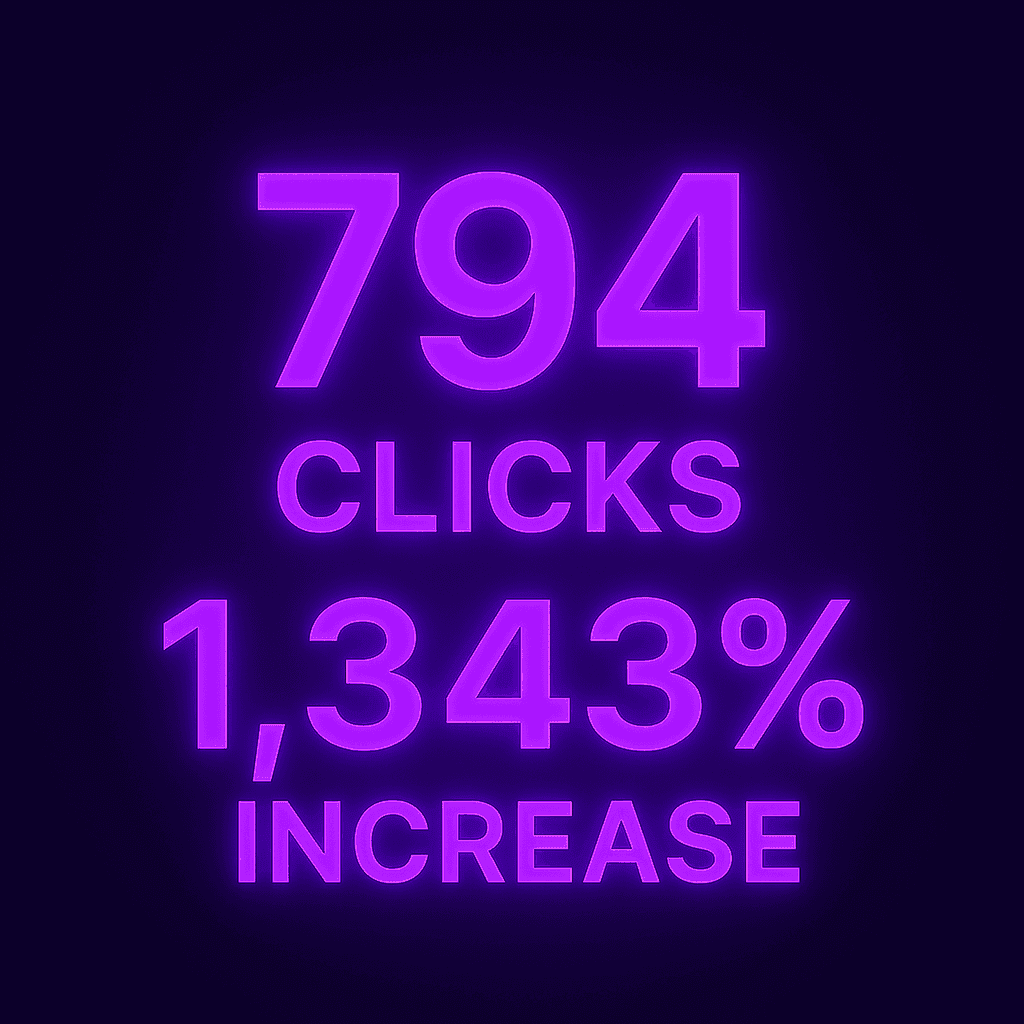
From 55 to 794 Clicks: +1,343% Organic Traffic
How We Grew a Shopify Plus Home & Living Store from 55 to 794 Organic Clicks
This European home and living brand had built a beautiful Shopify Plus store with 350+ products, but they’d never invested a single euro in SEO. Their entire acquisition strategy was Meta ads + Google Shopping, with €8,500/month in ad spend and rising CPAs squeezing margins. The starting point was brutal: 55 organic clicks per month on a site with 350+ product pages, zero content beyond product pages (no blog, no guides, no category descriptions), and no organic brand presence whatsoever. The CEO’s wake-up call: Meta CPAs had increased 40% year-over-year, and they needed a channel where returns grow over time.
The Challenge
This European home and living brand had built a beautiful Shopify Plus store with 350+ products, but they’d never invested a single euro in SEO. Their entire acquisition strategy was Meta ads + Google Shopping, with €8,500/month in ad spend and rising CPAs squeezing margins. Organic was essentially invisible.
Root Causes We Identified
- 350+ product pages with . Only manufacturer copy or bare product names
- No blog, no guides, no . Zero content beyond product pages
- Shopify’s default /collections/all/ URL structure creating crawl waste
- 800+ paginated and filtered URLs being crawled and indexed unnecessarily
- 4 unused Shopify apps injecting JavaScript and dragging LCP to 3.8s
- Meta CPAs had increased 40% year-over-year with no organic channel to offset rising costs
Tools & Platforms Used
Our Approach: Content-First in 3 Phases
Phase 1: Technical Cleanup & Speed (Month 1)
We restructured Shopify’s default /collections/all/ URL structure, added Product schema on all 350+ products, blocked 800+ paginated and filtered URLs from crawling, and removed 4 unused Shopify apps , improving LCP from 3.8s to 2.1s. This gave Google a clean, fast foundation to crawl.
Expert Insight
Speed improvements alone moved 3 existing product pages from position 15–20 to position 8–12 , before we’d written a single word of new content. Google rewards fast Shopify stores, especially on mobile where most home & living searches happen.
Phase 2: Content Deployment (Months 2–4)
This was where the growth happened. We created 15 collection page guides, transforming each collection from a bare product grid into a product grid + 800–1,200 word buying guide (e.g., “How to Choose the Right Dining Table for Your Space”). We published 8 blog posts targeting informational queries with purchase intent, rewrote 50 top product descriptions from manufacturer copy to unique content, and built comparison pages targeting high-intent queries.
What We Found
Collection pages were the single biggest growth lever. Most Shopify stores treat them as bare product grids. By adding 800–1,200 words of genuine buying guidance with interior design advice, each collection page became the best resource in the niche, and Google ranked them accordingly.
Phase 3: Internal Linking & Striking Distance (Months 4–5)
We connected every blog post to at least 3 product/collection pages with contextual links, added “Design Inspiration” sections to product pages linking to related blog content, and identified 23 pages sitting at positions 8–15 for quick Page 1 wins. Each blog post was designed as a traffic entry point that funneled visitors toward commercial pages.
What Didn’t Work (And What We Learned)
Two significant course corrections shaped the final strategy.
Generic “Top X” listicle format for collection guides
We initially wrote collection page guides as generic “Top 10 Dining Tables” listicle-style content. They didn’t rank. The format was too similar to affiliate review sites, and Google didn’t see an ecommerce brand as the right source for that content type. When we rewrote them as genuine buying guides with interior design advice, room measurement tips, and material comparisons (content only a home furnishing expert would write), they started ranking within weeks.
Programmatic AI product descriptions
We tested using AI to generate product descriptions at scale for all 350+ products. The output . Some were decent, others were generic or contained subtle inaccuracies about materials and dimensions. After quality-checking the first 50, we switched to manual writing for the top 50 products (by revenue) and left lower-priority products for a later phase. Quality over quantity was the right call.
Expert Insight
Google can tell when collection page content is generic listicle filler vs. genuine expertise. For ecommerce brands, the winning format is buyer’s guide content that demonstrates , not affiliate-style “best of” lists.
The Results: 5-Month Growth Engine
Headline Wins
- +1,343% organic click growth in 5 months
- 19 Page 1 rankings including 8 collection-level terms
- Blog content drives 34% of organic traffic with 15% higher pages-per-session than ad traffic
- Organic revenue grew from <1% to 18% of total revenue
- Google Ads spend reduced by €2,200/month
- Blended customer acquisition cost dropped by 28%
Key Takeaway: Collection Pages Are the SEO Secret Weapon
Most Shopify stores waste their collection pages as bare product grids with no text content. These pages have natural commercial intent, category-level authority, and internal links to every . They are the highest-leverage pages on any ecommerce site. By transforming 15 collection pages into genuine buying guides with 800–1,200 words of expert content, we created the foundation for 19 Page 1 rankings and a self-reinforcing loop of organic growth.
The EcomSEO Framework Applied
Technical speed fix → Collection page content strategy → Blog posts for informational intent → Internal linking connecting the funnel → Striking distance optimization → Iterate with GSC data. This content-first approach works especially well for Shopify Plus stores with large product catalogs.
Tools & Platforms Used
Work Together With SEO Experts who understand ecommerce
World’s first Ecom-founded SEO agency